Applications open for the course “Unlearning – Cultural Mediation Practices” in Porto

News - 14 January 2026

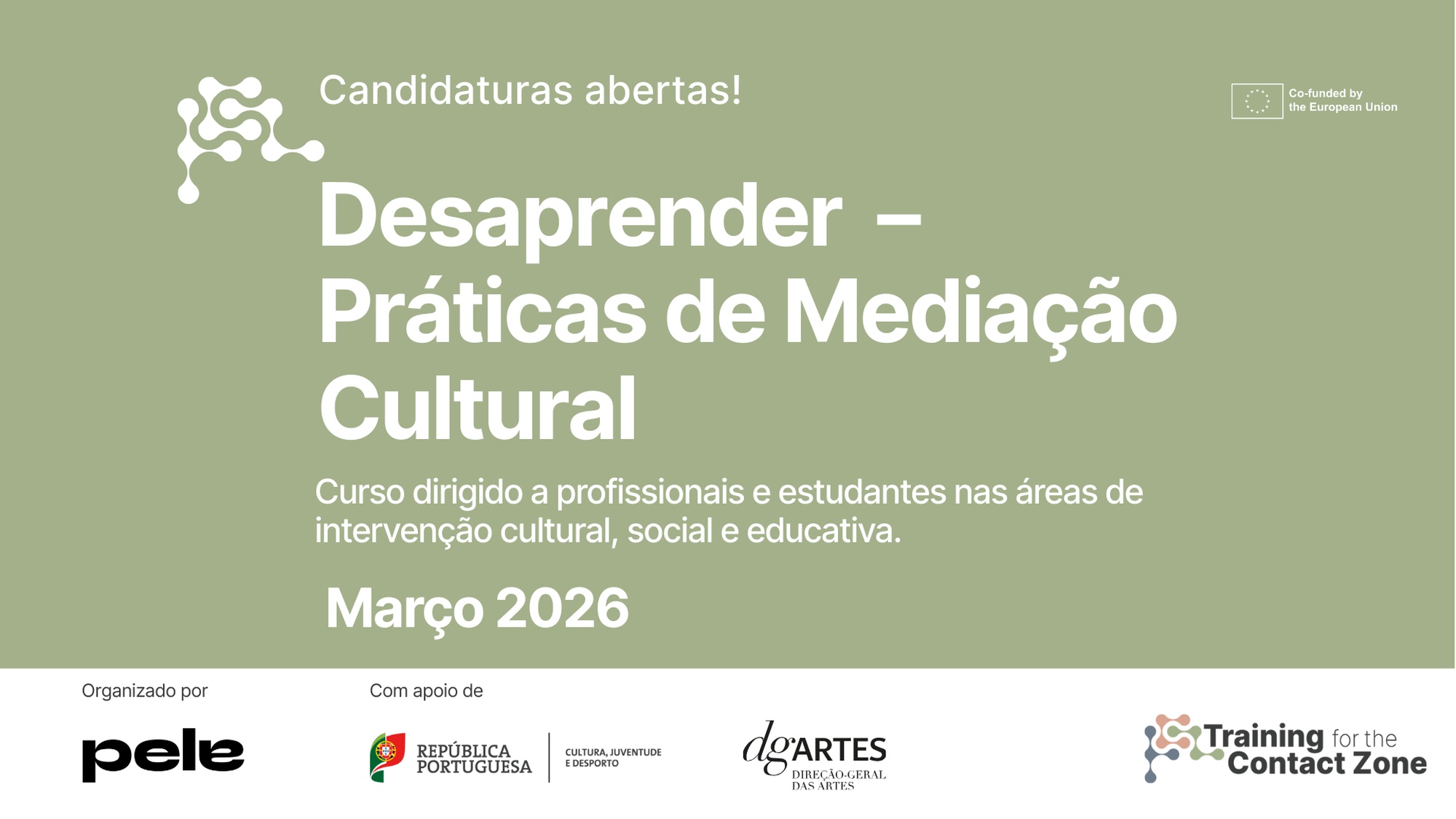
Applications are now open for the course “Unlearning – Cultural Mediation Practices”, a face-to-face training programme dedicated to the development of strategies for creating and mediating more just, representative and accessible cultural spaces and projects.

Aimed especially at professionals and students working in cultural, social and educational fields, this free training programme has a total duration of 32 hours — including 2 online hours and 30 in-person hours — and will take place in Porto. The sessions will be conducted in Portuguese.

Promoted by PELE, this initiative is part of the European project Training Contact Zone, implemented in seven countries throughout 2025 and 2026. The course focuses on the concept of the Contact Zone, understood as a cultural and social space where different perspectives, experiences and narratives can coexist and engage in dialogue.

In the current context, Contact Zones are becoming increasingly relevant as they challenge dominant narratives and amplify voices that are usually silenced or marginalised, encourage multivocality, promote empathy and understanding between diverse groups, stimulate processes of repair and re-signification of collective memory, and activate dialogue, creative experimentation and participation with underrepresented communities and groups.

The training programme is organised into six thematic modules, ranging from an introduction to Contact Zones and their contexts and practices, to tensions and opportunities in tangible and intangible cultural heritage, participation and cultural democracy, tools for cultural mediation, collective narratives of memory, representation and re-signification, and creative practices for reflection and evaluation.

The application period for this training programme is now closed. Applicants will be contacted with information regarding the selection process by the end of February.

The admission and selection process will be conducted by the PELE team. No appeals will be accepted, nor will individual comments or evaluation scores be disclosed.

Training dates:
In-person sessions: March 4 (6:00–8:00 pm), March 5 (10:00 am–5:00 pm), March 6 (10:00 am–5:00 pm), March 12 (10:00 am–5:00 pm), March 13 (10:00 am–5:00 pm), March 14 (10:00 am–2:00 pm)
Online session: March 19 (6:00–8:00 pm)
Training Curriculum:

Wednesday, 4th March

18:00 – 20:00
Programme to be confirmed

Thursday, 5th March

10:00 – 11:00
Module: Contexts and Practices of Contact Zones
Topic: Introduction to TCZ
Trainer: Maria João Mota

11:00 – 13:00
Module: Participatory Practices and Cultural Democracy
Topic: “What can cultural institutions do?”
Trainer: Maria Vlachou

Cultural institutions nurture their own narratives. Within them, we frequently find words such as encounter, dialogue, inclusion, tolerance, critical thinking, social cohesion… But what does this mean in practice, starting from within the institutions themselves?
Through real contemporary case studies, both national and international, we will analyse narratives and practices, question the capacity of cultural institutions to act in accordance with their stated principles, and seek to identify strengths and weaknesses.


14:00 – 15:00
Module: Contexts and Practices of Contact Zones
Topic: “From the Heritage Contact Zone to the Training Contact Zone – A chronology of Cultural Democracy”
Trainer: Lars Ebert (Participation online, session in English with automatic PT subtitles)

15:00 – 17:00
Module: Contexts and Practices of Contact Zones (webinar)
Topic: Contact Zones in the Practice of Cultural Mediation
Trainer: Denise Pollini (Participation online)

Mary Louise Pratt introduced the concept of “Contact Zones” in 1991 in the article Arts of the Contact Zone. Later, in 1997, James Clifford transposed this perspective to the museum context in Museums and Contact Zones.
Since then, international debates around the role of museums and cultural institutions in processes of decolonisation and repatriation of objects from contexts of colonial violence, as well as issues related to climate change, gender equality and ethnic justice, have demanded an urgent response from cultural agents and institutions.
Contact zones constitute permanently contested borders. As central entities in the production and dissemination of discourse, and as spaces that can reinforce symbolic structures of power, cultural institutions have a responsibility to integrate these issues into their programming. Facing conflict first requires recognising the need for an institutional stance on these matters and assuming the corresponding social, historical and symbolic responsibility.
How can cultural mediation respond to these challenges? The webinar Contact Zones in the Practice of Cultural Mediation proposes a reflection and debate on how this practice can generate spaces for dialogue and foster critical thinking processes, appropriate to the urgency of these issues in an increasingly polarised and unequal world. It is grounded in an understanding of culture as a crucial field for building collective and transformative responses.

Friday, 6th March

10:00 – 17:00
Module: Memory and Re-signification
Topic: Laboratory of the Senses
Trainers: Dori Nigro, Paulo Pinto

Laboratory of the Senses: Impatient Heart is a space for creative experimentation that integrates artistic practices, art/education and art therapy, promoting the awakening of body, soul and mind. The actions encourage the elaboration of memories and reflections on otherness, care and repair, weaving spontaneous networks of sensitive sharing. The processes emerge from socially generative themes and from the lived experiences of the artist-mediators, who have been developing this research and care project for years, in continuous dialogue between Brazil and Portugal.

Thursday, 12th March

10:00 – 13:00
Exploratory walk
Trainers: Maria João Mota, Janne Schröder

14:00 – 16:00
Module: Tools for Cultural Mediation
Topic: Voices of Mediation
Trainers: Anabela Rodrigues, André Sousa, Marta Bernardes and Matilde Seabra

16:00 – 17:00
Programme to be confirmed

Friday, 13th March

10:00 – 12:00
Module: Creative Practices of Reflection and Evaluation
Trainer: Vanessa Marcos

12:00 – 13:00
Module: Contexts and Practices of Contact Zones
Topic: Case studies
Trainer: Maria João Mota

14:00 – 17:00
Module: Participatory Practices and Cultural Democracy / Cultural Mediation Techniques
Topic: Theatre of the Oppressed – A methodology of participation and cultural mediation
Trainers: Atija Assane and Beatriz Villas Bôas (Uma Pausa Teatral)

Through exercises from the Theatre of the Oppressed, we will promote physical and emotional self-awareness and group integration, stimulating the participation of each body within a collective body. From there, we will reflect on a state of community, in which each participant contributes according to their abilities and limitations, while also being aware of the limits of other bodies.

Saturday, 14th March

10:00 – 14:00
Module: Contexts and Practices of Contact Zones
Topic: Case studies – Presentations
Trainers: Maria João Mota, Fernando Almeida, Janne Schröder

Thursday, 19th March

Module: Contexts and Practices of Contact Zones
Topic: Final Reflections
Trainer: Maria João Mota