
Narratives of Migrant Women in the City of Porto
"Mapa Delas" was created within the framework of the Municipal and Intercultural Mediators project, promoted by Porto City Council, and is part of PELE’s long-standing work of mapping, building connections and maintaining ongoing dialogue with different groups across the city.
The stories were shared by migrant women who live or work in Porto, through an open call held in October 2025. Priority was given to narratives by women from different geographies, contexts and age groups, who in some way are engaged in collective or community-based action.
This material, however, is not representative of the full cultural diversity of the city of Porto; many stories remain unseen and could have been part of this project. Nevertheless, this artistic object seeks to function as a small device for valuing knowledge and identities, and for celebrating the plurality of existences in society. "Mapa Delas" aims to raise awareness, foster closeness, make human journeys visible, and strengthen networks of care, support and solidarity between communities.
Jamila Rezayee
20/02/2002
Ghazni, Afghanistan
I am a Hazara woman from Afghanistan. My story begins in the home where I grew up, amid the smell of warm bread made by my mother and the gentle voice of my father reciting sacred verses. My dreams were always greater than the world around me seemed to allow. Every time I was told “you can’t,” a small light inside me grew stronger. I wanted to study, to write, to be a woman and to be free to think.
(...)
University was an open door to the future, but behind it there were also fears and limits. Many times, amid silences and heavy looks, I whispered to myself: “Jamila, be calm. This is your path. Go on, even if sometimes you have to walk alone.” These silent dialogues with myself gave me the strength to continue.
(...)
Here in Portugal, I began to feel what it means to live with more freedom as a woman. I found an environment where there are more opportunities to study, grow, and build my future.
(...)
When I walk through the city, I see women everywhere — in parks, cinemas, concerts, cultural festivals, universities, and workplaces — women who are present with calmness, confidence, and joy. Seeing these images awakens hope and possibilities in me.
(...)
In Afghanistan, many girls face severe restrictions and are not always able to continue their studies or live freely in society. I grew up in a context where being a girl meant learning early the weight of certain limits. But it was precisely within these challenges that my inner strength was formed.
(...)
Because of the language, I accompany my father and mother in many everyday situations — at the hospital, while shopping, and in public services. Here, roles have shifted a little, and it is I who help them find their way in a new country and a language they are still learning. Their effort to remain strong and not worry us teaches me every day the true meaning of dignity, responsibility, and love. Life here is a new beginning, and whenever I can, I try to give them strength, care, and hope.
(...)
Over time, I realized that a homeland is not just a piece of land. Sometimes, a homeland lives in the hearts of the people we love — in the gaze of my father and mother who always support me, in the presence of my siblings here in Portugal, in the prayer of my husband who accompanies me from afar, and in the silent faith of a woman who never gives up.
(...)
Today, I am a woman who rose through pain. I created roots in the midst of exile, with tears and smiles, with fear and courage, with patience and resilience. I learned that every woman, even far from her land, can build a home within herself — a home made of voice, love, and strength.
Julieta Fuxi Alexandre Vaz
06/06/1993
Cacuso, Malanje, Angola
My name was given to me by my father. The name “Fuxi,” in my mother tongue, means “source” or “power,” and when it is not a “family name,” it is the name given to people born after twins in Ambundu culture. I was born in Malanje, a province in north-central Angola. I have always lived a very itinerant life, not only because I was born in a context of war and displacement, but also because from a very early age I believed that the fulfillment of my dreams lay beyond the place where I was born. My father was killed during the war. I don’t really know where I am from; I have always seen myself as a citizen of the world.
(...)
Porto gains a lot from having people who, because they come from different contexts, are able to read reality beyond what most people know. I come from a marginalized place and I work with marginalized people, which allows me to act from my own standpoint and gives me some advantage compared to the people I work with. If I am speaking about, with, or for immigrants, I can understand their needs and the feelings they express, due to my condition as an immigrant. With African people, I have the cultural sensitivity to interact or intervene without fear of prejudice or racism, but also without the coloniality that often permeates social discourses and practices. This sensitivity extends to other ethno-cultural groups, such as the Romani community. In other words, by being able to position myself in different standpoints, I add value to community intervention, contributing to more appropriate, inclusive, and effective responses that result in greater justice and social cohesion.
(...)
I like people from Porto because they talk a lot. In Porto, it feels like being at home, because in my country everyone talks to everyone. When I get lost and approach someone to help or guide me, if they can, they walk with me to where I need to go — my people are like that too.
From Porto, besides the people, I am also a big fan of "francesinha", so much so that it is part of my monthly food ritual. If I go a month without eating it, it feels like something is missing.
(...)
I want to be Minister of Social Action, Family, and Gender Equality in my country. That is why I am part of a community intervention team and why I am doing my PhD. I want to work in Social Action because I come from a very rich country, but the level of inequality and social vulnerability is extremely high.
Claire Sivier
07/06/1985
Londres, England
I am a woman, a friend, a sister, a daughter. A Black person, a biracial person, a queer person. I am a multiplicity. Here I am an immigrant, but I come from a second generation of immigrants (a Jamaican father and a French mother) in London. I feel that I was shaped by the environment where I grew up, with friends from India, Morocco, Nigeria… My whole neighborhood was like that. All my friends were children of immigrants. As a young person, and even before knowing the word, I think I always understood the intersectionality of my experience, including in relation to other Black people. I understood that I am a Black person, but that I also have light skin, and therefore my experience is different from that of other immigrants. I understood — and continue to understand — the privileged position I have compared to darker-skinned Black people; I saw this difference in experience clearly in close family members and, here in Portugal, I also see the privileged position of holding a British passport.
(...)
The “Black Women’s Walk” emerged from a personal need. It is an informal group of Black women and Black non-binary people who come together to enjoy nature and public spaces — places where our bodies are not usually expected — and it generally happens once a month, in addition to retreats and other outdoor activities that we organize. I was born into an environment with many Black people and, when I moved to Porto, I felt lonely and was shocked because I did not regularly see Black people. But we are here, there are many of us; at the time, my experience was very shaped by and relative to where I came from in London.
(...)
I like it when we walk near the water. Near the river, near the sea, because it is something very symbolic. Many of us are Atlantic peoples, and water is a point of connection between us, since we come from different nationalities within the group. When we walk near the river in Fontainhas, when we walk to Foz, or when we pass through Miramar, that path, that water, creates a very important connection, and I feel that we become calmer. It is a great privilege, because the river here in Porto is part of the city’s identity.
(...)
My dream is to continue this resistance in the public sphere and for more people to join and feel at home in our group. We feel safe together; we can take care of one another. I think that if I hadn’t started the group or met my friends, I would no longer be in Portugal. When I created the group, I was alone, but it was very important to open it up and receive support from other people who also wanted to help develop it. I realized it needed to be open. That is why we are now a group of volunteers — especially because I cannot, and should not, represent all Black people.
Michele Mara
01/03/1981
Curitiba, Brazil
I am a singer, I hold a degree in music therapy, I am a composer, an actress, and a Black activist.
I studied theology to become a pastor for children and the church. I was a singer and choir conductor — in short, I was raised to be the successor pastor in my family’s church. But one day I found the courage to change my life and enrolled at the Curitiba Conservatory of Music to study popular singing. I ended up being pushed out of the church, because I had to choose: either I sang in the church or I sang for the world… I chose the world.
I studied music therapy at university because I wanted to work with Black women who were victims of domestic violence and to support them through grieving processes. I conducted the first research in the world on the feelings Black women express in music therapy activities.
I am not a woman of the Black movement, but I am a Black woman in movement…
(...)
I bring my ancestry, my history, my life, my art. I bring my mouth open to speak, I bring refusal to be silenced, the fight for justice and reparation, the fight against xenophobia, against machismo, and the desire for change. I can no longer be a “wikipreta” — people have to make an effort to learn; we are not here to teach, we are here to fight…
That is what I bring: struggle, resistance, and my life to help whoever needs it.
I am an African womanist grounded on three pillars: race, class, and gender, with women at the center of everything. This is Matriarchy.
(...)
Porto is very special because it is here that my career as an artist and entrepreneur (re)begins.
I had a lot of earrings and necklaces made from cardboard and African fabric, which I started making during the pandemic and needed to sell. That is how the idea of organizing the first Afro-Entrepreneurs Fair in Porto emerged, in 2021. From there, I made new connections that led me to participate in musicals and to join the first Portuguese Creole opera, “Adilson”, by Dino d’Santiago.
(...)
I wish to grow older with health and quality of life. To continue working and to provide for my children, not to be counting coins at the end of the month. To do more musical theatre, maybe cinema, to travel, to record my album…
Deusa Sebastião
Guinea-Bissau
My childhood was not easy. I left my country, Guinea-Bissau, very early… I experienced great hunger, I suffered a lot. At the age of six, I went to work for a man in Senegal. I lived like a slave, guarding animals so they would not eat or destroy what had been planted. One day, the man wanted me to become his wife. I ran away and returned to my parents’ home. All that suffering made me the woman I am today. I have worked as a mechanic, in hotels, restaurants, and cleaning jobs… Now I wake up every day at 3:30 a.m., I am out on the street by 4:00 a.m. to catch the bus, because I start work at 5:00 a.m. I am proud of the woman I am.
(...)
Africa lives inside me! I brought a little piece of Africa to Porto, and with me I always carry joy! "Beleza Africana" is my safe place in Porto and the result of a lifetime of effort. It is a hair salon where I do what I love most and where I welcome everyone — because this place is for everyone! At "Beleza Africana" there is good energy, and whoever comes in leaves happy, beautiful, wonderful, and powerful!
(...)
In January, I will complete fifteen years in Porto — a journey marked by hard work and struggle.
I carry with me the longing for my country, but it is here that I find safety and freedom of expression. Here I have space to say what I think, to affirm who I am, and to make others happy.
In Porto, I walk without fear and inhabit this city with freedom, knowing that my voice can exist.
(...)
I dream of offering my loved ones a more dignified life, after everything they went through with me.
As I could not be a mother, I imagine a place where I could welcome those in need. If one day I had the means, I would build a home or orphanage, where I could help others and give them a fairer future.
Abida Hasana
25/06/1993
Rajshahi, Bangladesh
I was different from other girls my age, and perhaps because of that I was not treated with much affection. I was very interested in new things and wanted to explore the world. My family was very conservative, so I was highly repressed. I left my parents’ home at a very young age to study; I took a Fine Arts degree at university and specialized in Ceramics. I am the mother of two children and I truly enjoy motherhood. I am someone who tries to be aware of all aspects of our daily life, including education, well-being, and the political situation. Politics occupies a very important place in our home — my husband and I have many conversations about the political situation in Portugal, in Bangladesh, and in the world.
(...)
I have the will and desire to become more deeply involved in my community, especially with women, so that they can feel socially present, connected to one another and to the world around them. I want participation and connection to replace hardship and isolation. I carry with me the idea of collectivity — paths built together, with more integration and less individuality.
(...)
In Porto, I enjoy the silence and calm, which are very different from the chaotic place where I lived in Bangladesh. People in Porto are kind and communicative. What I like about Porto is the sun and the climate; it is similar to where I come from. Walking through the city is a ritual — I gradually recognize the space, the time, and the place I inhabit.
(...)
Language is the greatest barrier to integration, and the process of learning the language is essential for full integration. I believe this learning process should be promoted and supported for a longer period of time. How can one practice, and where can one practice Portuguese? This is one of the major integration challenges for the Bangladeshi community.
In Bangladesh, we are very outspoken and politically active. Here, I would like to get closer to groups and movements that advocate for social issues and to motivate others to do the same.
I dream of holding a political position in which I would have the power to make a real impact in the community. I would love to see myself in that position, to be able to solve as many problems as possible — because a leader has a different kind of power than ordinary people, right?
Marlene Pacheco
03/01/ 1951
Florianópolis, Brazil
I was born in the circus, and when I was seven years old my parents decided to leave the circus so that their children could study. There was no work for my father, so life was very difficult. We lived in a shack, on a small piece of occupied land. We went hungry.
I am a teacher, and I was born to be a teacher! When I retired from administrative work, I kept teaching until the day I was told I was no longer allowed to teach. School and my students were my joy and my life!
It was then that I decided to come to Portugal with my granddaughter, at the age of 72. Here, joining the Portuando association made me pay even more attention to social problems and become more active in the struggle. I currently teach English to immigrants at a social price. Being an immigrant woman made me more aware, more present, more active.
(...)
I have a huge desire to participate, to be present, and to live the city of Porto intensely. At Portuando, I support Brazilian immigrants who arrive here; at home, I open up space to share knowledge and offer my English classes at a social price, because teaching is also my reason for living.
(...)
I fell in love with the city, with public transport, with the cultural offer, with the people. I fell in love with everything! It felt like I had been dropped in the right place — I felt at home and safe. The similarities with Florianópolis made me feel a strong connection to this place. Here and now, I do what I love and live where I feel at home, even if it is just a room…
(...)
Housing is a major challenge for me and for everyone. I currently live in a room, and what I earn from my pension almost only covers accommodation.
I am concerned about the inhumane way some services treat people, especially when they are in the fragile and vulnerable condition of being immigrants.
(...)
I wish to continue my L.IFE by moving through the city and making the most of the opportunities it gives me! I feel that I can have a great J.OURNEY! The L has lots of twists and turns, but once you enter the JOOOOURNEY, you just enjoy the ride.
Coming from the circus, I couldn’t help but take part in some theatre initiatives here in Porto. I still want to win the Oscar for Best Actress in 2050.
Lyudmyla Artysh
08/03/1974
Rivne, Ukraine
I am a woman, a mother, a wife, and a nurse.
I chose to emigrate and have lived in Porto for many years. Most of my life was built here. That is why a part of me is already Portuguese, and I can also say that I am from Porto.
It was in this place that I learned a deeper empathy — a learning process very much inspired by the Portuguese people. I founded a Ukrainian educational and cultural center to support integration, but also to preserve who we are: our language, our memory, and our identity, shared with those who welcome us.
(...)
I want to live in this territory that I already feel is mine. I have been building relationships, and one of my projects is a Ukrainian cultural and educational center, the Metropolitan Area of Porto Hub of the Association of Ukrainians. It consists of a Ukrainian school, a folk group, and a structure to support immigrant integration and the development of Portuguese language skills.
I live with the desire to bring Ukrainian culture to the people of Porto and to promote interaction between Ukrainian culture and Portuguese culture.
(...)
I think I have finally managed to feel that soul everyone talks about — the soul of Porto. A unique soul, with its own strength. I love walking through the city center, feeling the pulse of the streets and the openness of the people, the empathy revealed in small gestures and attentive looks. Parque da Cidade remains my favorite place.
(...)
I feel that language is the biggest challenge as a Ukrainian immigrant.
I notice that differences in the way everyday situations are faced and resolved have a major impact on the lives of Ukrainian immigrants.
(...)
I wish to continue my projects: to support the Ukrainian community in its integration into Portuguese society. I wish to share our culture, celebrate our folklore, and keep alive an identity that was once erased and that connects us to our roots — showing it with pride to those who welcome us.
Daria Yeremenko
02/01/1994
Svitlovodsk, Ukraine
I was born in a small town in Ukraine: a place of light and water. Later, I moved to Kyiv. It was not a decision guided by a professional strategy or a clearly defined goal. I went because someone important to me lived there and I wanted to be close. At that moment, I had no direction of my own, and that is also part of my story.
Leaving Ukraine was not a choice. I left on the second day of the war. I took with me only a backpack, with the least suitable things. I was convinced that I would return quickly, and so I did not bring my favorite clothes, thinking they would only get ruined in the shelters and along the way.
My way of being in the world is through performance. I work as a dancer, choreographer, and educator. I am interested in creating situations where attention, contact, and shared action emerge.
(…)
To Porto I bring movement as a way of acting, initiating processes, and engaging in interaction. Collaboration and the building of bonds with real presence are central to me.
(…)
When I arrived at Porto airport, a friend I barely knew, Romani, brought me water. In that gesture, I recognized a strange form of care, minimal and, at the same time, maximal.
(…)
Communication is the greatest challenge I face. Not because of the language as a system, but because of the meanings, words, and gestures that carry codes I am still learning to decipher. This misalignment of rhythms sometimes creates a feeling of distance, as if I am moving alongside, but not within, the common time.
(…)
I want to be an agent of movement. Today I see this path in the creation of my own dance company, a shared and responsible workspace, because work of this kind does not exist in isolation.
Najat Ougali
12/07/1997
Tinghir, Morocco
I was born in a village very close to the desert. My childhood was simple and happy; I remember spending time playing with my friends and discovering the world around me. My grandmothers taught me the customs and traditions of the family and gave me advice for life: be patient, respect others, take care of myself and my health, and help those in need. As a child, I dreamed of becoming a doctor, but I got married at 18 and could not continue my studies. We left Morocco in search of a better future for ourselves and our children.
(…)
In Porto, I like the weather, the tranquility, and the opportunities I find in education and health. Here, I do not feel racism.
My neighbors are helpful and attentive, and on the paths I walk every day, I am greeted with smiles and a “good morning” that makes me feel welcome.
(…)
Being far from my family brings longing, but the desire for a more stable life brought me here.
Here, I face some challenges: the Portuguese language is still a barrier, the delay in obtaining residence authorization requires patience and persistence, and the problems related to the housing crisis have affected us.
Even so, I move forward, with hope for safer and calmer days.
(…)
In the future, I dream of a more stable life and a safe home. I wish for my children to have access to an excellent education and to grow up in a world where they can live with dignity, tranquility, and peace.
Natalia Matveeva
22/04/1969
Nizhny Novgorod, Russia
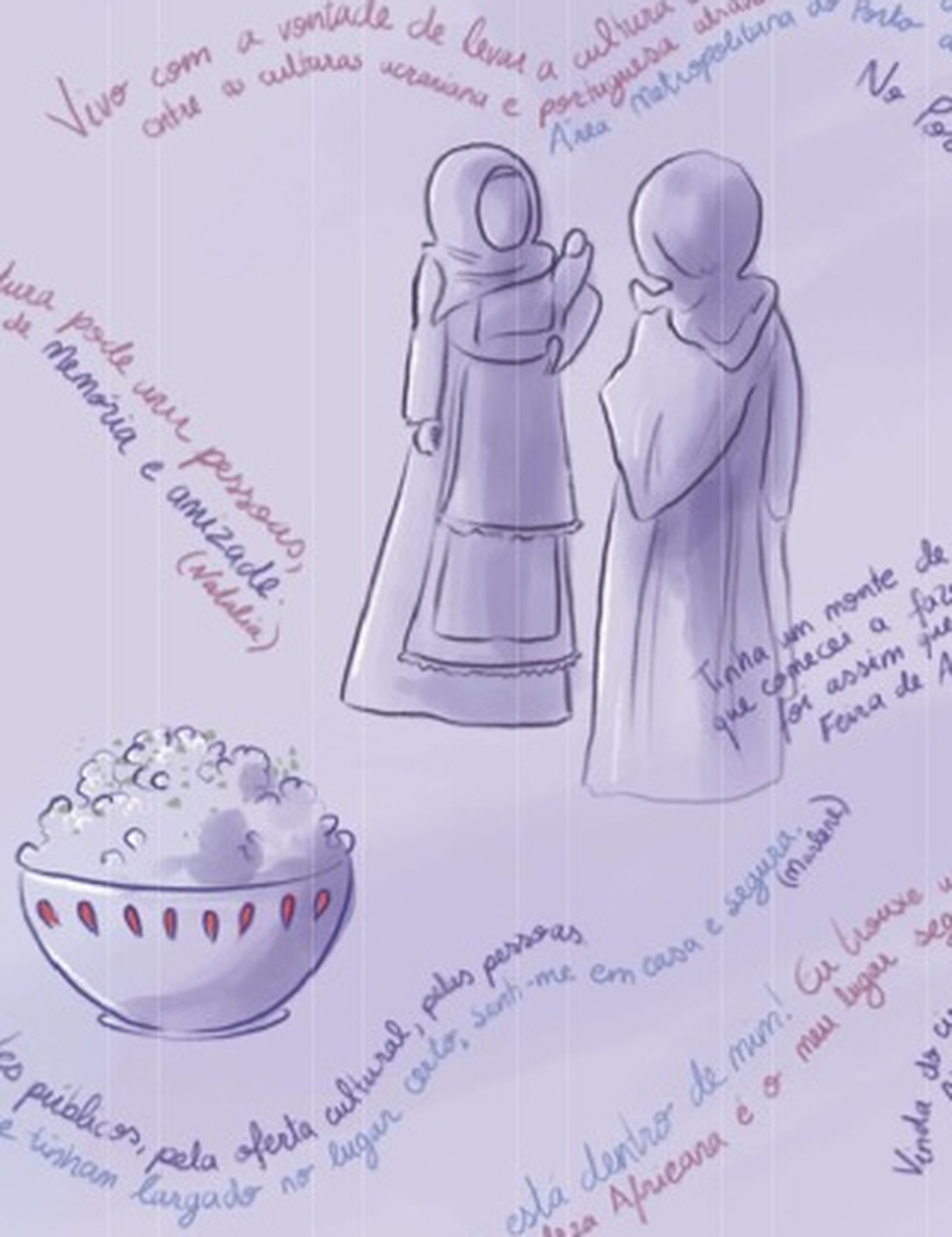
I am a psychologist, but here I am still unable to practice my profession because the process of recognizing my qualifications is very expensive and time-consuming. I dedicate myself to studying cultures through the creation of folkloric dolls. These dolls exist in all peoples—they are archetypes and reflect universal values, regardless of country or nationality, preserving stories and memories about the customs and ways of life of each people.
(…)
I make dolls together with my Ukrainian friend. For us, it is a way to show that culture can bring people together, even when they come from different countries. For the Russian and Ukrainian communities, it is a sign of memory and friendship; for the Portuguese, it is an invitation to learn about our roots and their value.
(…)
What I like most about Portuguese people is that there is always someone willing to help. The beauty of the city still impresses me. When we arrived, it was October; the sun was still shining and I still saw many flowers. In Russia, it is already very cold at that time. I felt like I was in a Hans Christian Andersen fairy tale.
(…)
I would like to continue creating cultural projects that bring people together, deepen the dialogue between traditions, and find new forms of joint creativity. I want my initiatives to help strengthen the sense of community, open new horizons, and bring joy to both Portuguese people and representatives of other cultures.
Gabriela Barbosa
17/06/1982
São Paulo, Brazil
I am a woman who has taken ownership of her own life.
I am the youngest daughter in my family and chose the path of respecting myself and following my own desires.
I studied Biomedicine, worked for years in the pharmaceutical industry, was engaged… At 30, I realized that this was not what I wanted… Today I do exactly what I want. I greatly value the freedom I have to decide my movements and the choices that brought me to where I am. As women, we are not taught to choose ourselves. Beyond practicing this idea in my own life, I encourage other women to do the same.
(…)
I arrived in Porto with 300 euros in my pocket, a 21 kg suitcase, and confidence. I had never lived alone, didn’t know anyone, had no one to rely on. We left an environment surrounded by people who cared for us and suddenly we were in a place where no one knew who we were. I stayed for 22 days inside a 15m² studio apartment, locked in that house, afraid to leave because I didn’t know anyone, and short on money because it was holiday season and I had no contract. I learned a lot from my own demons, from fears I didn’t even know I had.
(…)
The people of Porto are very proud of their land, and this was one of the first things that caught my attention when I moved here. The story told by the monument at the Rotunda da Boavista always brought me to a parallel place in my life as an immigrant: resistance. Just as the Lion resisted the invasion of the Eagle, I see myself as a resistor within a space where I (we) am (are) seen as an “invader”…
(…)
Casa Odara represents many groups of people who are considered marginalized in society. Art, when created by these dissident groups, is not valued. As an association, we can be a vehicle to help anyone who wants to develop ideas and projects. "Casa Odara" drives and vibrates energy so that we are all together in the daily struggle for existence and resistance.